Know before you ride

E-Bikes in Solon

E-bikes are everywhere on Solon streets now. Here's how to ride one safely, what Ohio law actually requires by class (including the Solon Police Department's own rundown), and what doesn't count as an e-bike at all.

Ride smart

E-Bike Safety Tips

Core advice from the League of American Bicyclists: normal safe-cycling habits still apply, but the extra weight and speed change a few things.

Before you ride

What's different about an e-bike

  • Helmet: a standard bike helmet is certified for slower, pedal-only crash speeds (CPSC in the US, EN1078 in Europe). E-bikes regularly go faster than that, especially Class 3. Look for a helmet certified to NTA-8776, a standard built specifically for e-bikes and speed pedelecs, tested for impacts up to 28 mph with more coverage at the temples and back of the head.
  • Weight: e-bikes are heavier than standard bikes, which means longer stopping distances and different balance at low speed. Practice starting, stopping, and maneuvering before you're riding in traffic.
  • Throttle: ease into it. A sudden snap of throttle can catch you off guard, especially pulling out from a stop.
  • Brake early: more speed and more weight both mean more distance to stop. Start braking sooner than you would on a regular bike.
  • Battery: charge with the manufacturer's charger only, don't leave it charging unattended overnight, and never charge a damaged or swollen battery.
  • Tire pressure: check it more often. The extra weight of the motor and battery puts more load on your tires than a regular bike carries.
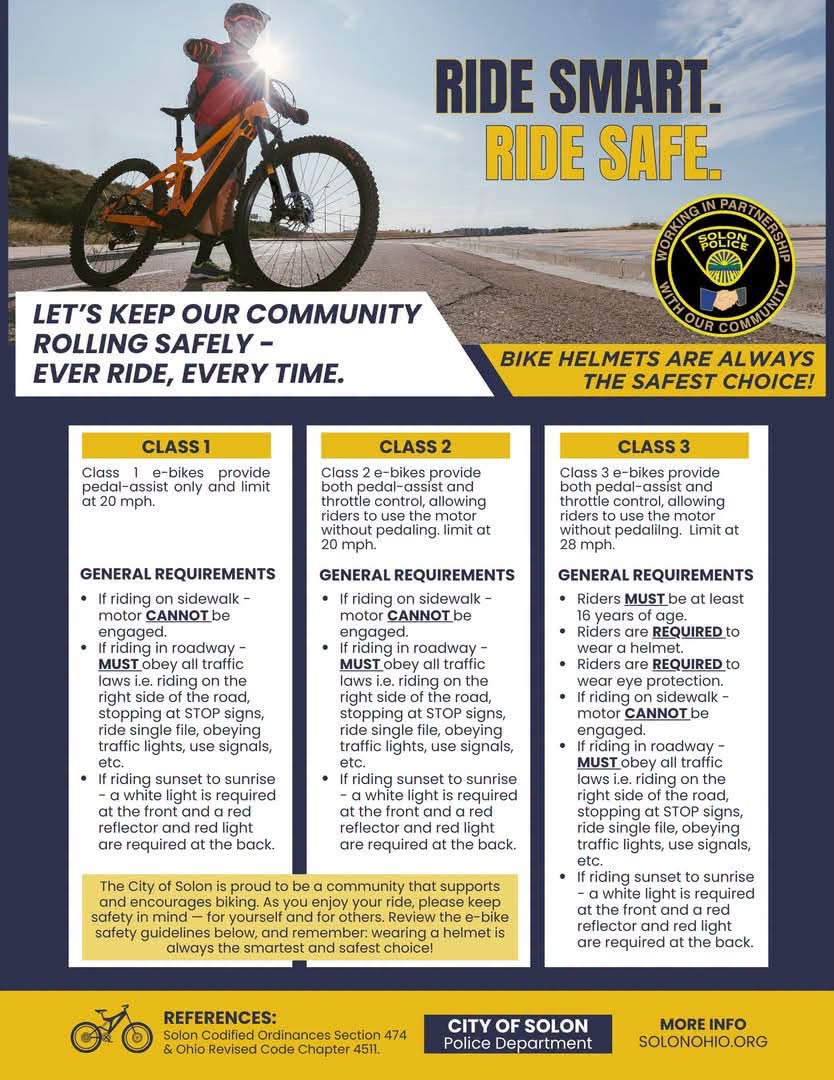
Solon Police Department 'Ride Smart. Ride Safe.' e-bike safety infographic, showing a young rider on an e-bike and breaking down Class 1, 2, and 3 e-bike speed limits and requirements. Full text is transcribed below.
Source: Solon Police Department, via Facebook. Tap to zoom.
Ohio Revised Code Ch. 4511

The three classes

Every e-bike on the road falls into one of three classes. The class determines the speed limit, and for Class 3, some extra rules.

01
Solon Cod. Ord. § 474
Ohio Rev. Code Ch. 4511
pedal-assist only · 20 mph

Class 1: pedal-assist

The motor kicks in only while you're pedaling, and cuts out at 20 mph. This is the most common e-bike on the road, and the least restricted of the three.

General requirements
  • Riding on the sidewalk: the motor cannot be engaged
  • Riding in the roadway: must obey all traffic laws, ride on the right side of the road, stop at stop signs, ride single file, obey traffic lights, and use hand signals
  • Riding sunset to sunrise: a white light is required at the front, and a red reflector and red light are required at the back
02
Solon Cod. Ord. § 474
Ohio Rev. Code Ch. 4511
pedal-assist + throttle · 20 mph

Class 2: pedal-assist + throttle

Same 20 mph limit as Class 1, but a throttle lets the motor move the bike without pedaling at all.

General requirements
  • Riding on the sidewalk: the motor cannot be engaged
  • Riding in the roadway: must obey all traffic laws, ride on the right side of the road, stop at stop signs, ride single file, obey traffic lights, and use hand signals
  • Riding sunset to sunrise: a white light is required at the front, and a red reflector and red light are required at the back
03
More rules apply
Solon Cod. Ord. § 474
Ohio Rev. Code Ch. 4511
pedal-assist + throttle · 28 mph

Class 3: pedal-assist + throttle, higher speed

Same pedal-assist-plus-throttle setup as Class 2, but capped higher at 28 mph. That extra speed comes with extra requirements.

General requirements
  • Riders must be at least 16 years old
  • Riders are required to wear a helmet
  • Riders are required to wear eye protection
  • Riding on the sidewalk: the motor cannot be engaged
  • Riding in the roadway: must obey all traffic laws, ride on the right side of the road, stop at stop signs, ride single file, obey traffic lights, and use hand signals
  • Riding sunset to sunrise: a white light is required at the front, and a red reflector and red light are required at the back
Know the difference

Not an e-bike

Sur-Ron style e-motos, mini dirt bikes, and other throttle-only machines are a different thing entirely, and none of the rules above apply to them.

04
Private property only
ORC 4511.01
off-highway machine
no pedals and/or over 750W

E-motos, Surrons, and mini dirt bikes

An e-bike in Ohio has to have working pedals and a motor of 750 watts or less. A Sur-Ron or similar e-moto usually has neither: no pedals, and a motor well past that limit. That means it doesn't qualify as an electric bicycle under ORC 4511.01, and none of the Class 1, 2, or 3 rules above cover it.

Where it's actually legal to ride
  • Private property, with the landowner's permission
  • A licensed off-road or motocross facility
  • Not the sidewalk, a bike lane, a multi-use path, or the road: those all require the vehicle to be titled, registered, insured, and licensed like a motorcycle or moped, and most e-motos aren't built to meet that bar
One more rule worth knowing

Class 3 e-bikes (throttle, 28 mph) are already prohibited on multi-use trails and shared paths under ORC 4511.522. If you're headed for the Solon-to-Chagrin-Falls connector or another shared-use path, stick to a Class 1 or Class 2 e-bike, or a regular bike.

Riding to Solon City Schools

Solon City Schools bans throttle-equipped e-bikes on all district property, upheld again for the 2026-27 school year. It doesn't change the state law above, but it does mean a Class 2 or Class 3 e-bike can't come to campus. Read our statement from when the ban was announced, and see our campaign to reverse it for where that stands.

Questions about the rules

Got a question, or see something that needs updating here?

For official rulings or enforcement questions, go straight to the source. For corrections to this page, tell us.